Foundation piering in Fort Wayne costs $1,200–$3,000 per pier, with most settlement repairs needing three to eight piers — $4,000–$15,000 total. Piers are driven hydraulically to refusal on stable bearing, which in Allen County's layered glacial deposits varies from pier to pier.
Here's what settlement means on this ground, and how a pier ends it permanently.
Settlement here is usually a water story
Fort Wayne isn't a shrink-swell market the way Texas or Oklahoma is — our foundations don't generally settle because clay dried out and contracted. They settle because bearing soil got weaker. Saturated soil carries less load than the same soil drained. Trench backfill around a foundation, disturbed during construction and never compacted to native density, consolidates for years afterward. And a downspout or a failed drain line concentrating water at one corner can wash fines out of the soil beneath a footing entirely.
The result reads the same as settlement anywhere: stair-step cracks through brick or block, doors that won't latch, floors sloping toward one wall, a porch or chimney separating from the house. What differs is the fix list — here, correcting the water source is usually part of the repair rather than an add-on, because otherwise the surrounding soil keeps doing what it did.
What a pier actually is
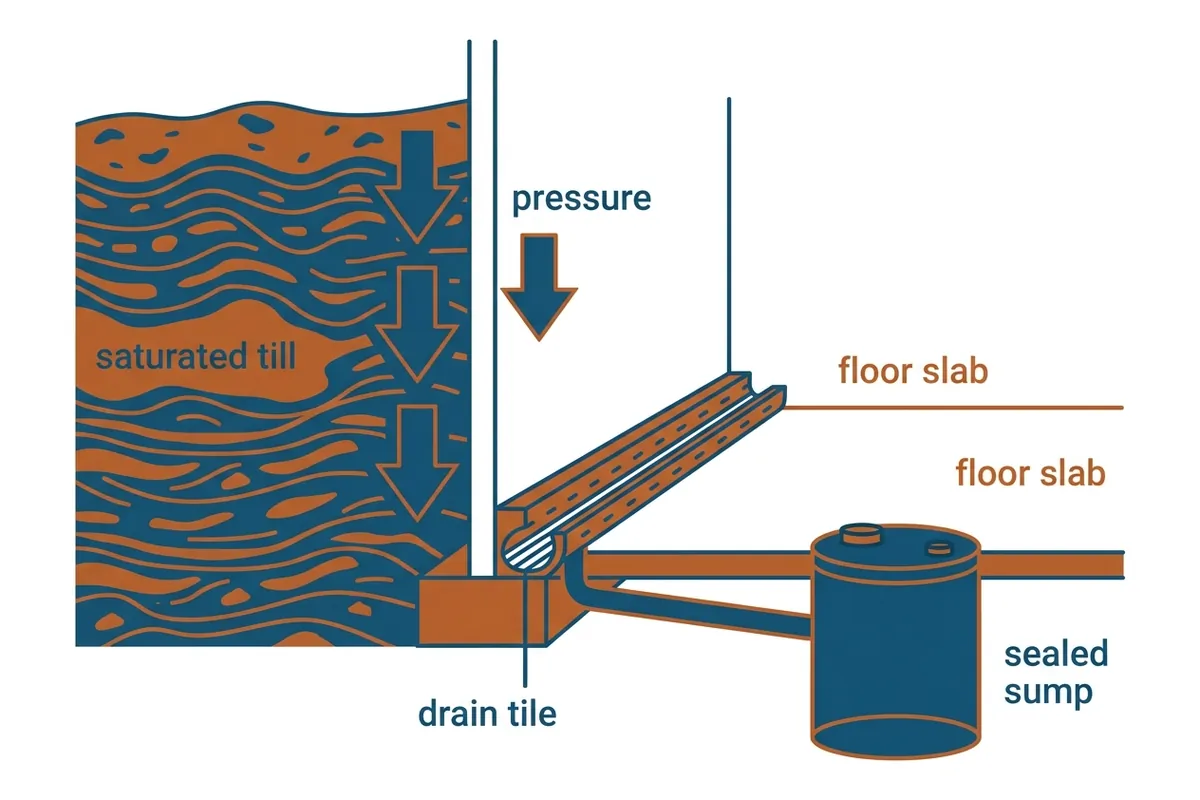
A steel pier is a column driven beneath the footing by hydraulic ram, section by section, until it refuses to advance — meaning it has reached material capable of carrying the load without further movement. A bracket bolted to the footing transfers the structure's weight onto that column. The house stops standing on the layer that failed.
Refusal depth in glacial terrain is genuinely unpredictable, which is a feature of honest work rather than a problem. Till, sand lenses, and lakebed clay interleave across short distances here, so each pier is driven to its own depth and its refusal pressure recorded. A crew installing every pier to the same specified depth is guessing.
What sets the count and the price
- The affected run — determined by laser floor elevations, not by square footage
- Refusal depth — deeper refusal means more sections per pier location
- Foundation type — full basement walls, crawl footings, and chimney or porch footings each carry different bracket work
- Access — established landscaping and tight side yards in the older neighborhoods add labor
- The water correction — nearly always priced with it here, and usually the cheaper half
Timeline and lift
Most piering runs two days to a week depending on count and access, and the house stays livable throughout. Where lift is attempted, it's synchronized across piers and monitored against interior crack widths in real time. Stabilization is what we promise; recovered elevation is what we attempt. On a house that has moved over decades, some of it is permanent, and you'll hear that before the work starts rather than after.
Which pier belongs under this house?
Glacial till is dense, which sounds like good news for piering and mostly is — drives find real resistance. The complication is water: a high table and slow-draining clay mean the till's strength changes with its saturation.
| Option | What it does | What the ground here decides |
|---|---|---|
| Pushed steel | Pressed to refusal against the house's own weight | Reliable in dense till — refusal readings here mean what they say |
| Screwed steel | Advanced until a measured torque is reached | The choice for additions and porches without the weight to press against |
| Cast concrete | Placed and cured against firm strata | Used at depth where lakebed clays sit soft over the harder till |
Verify capacity at the wet extreme, not the dry one. A pier proven in a dry October meets a different soil in a saturated spring.
Piering questions, straight answers
How many piers will my house need?
Most settlement repairs here use three to eight piers, placed where the floor-elevation survey shows the footing actually dropped rather than spaced evenly around the perimeter. Counts usually cluster along one run — commonly the side with the drainage problem, because on this ground saturation is what softens bearing soil.
How deep do piers go in Allen County?
Until they refuse. Piers are driven hydraulically section by section until they stop advancing against stable material, and the refusal pressure is logged per pier. Glacial deposits vary layer to layer across a single lot, so depth is measured rather than specified in advance — two piers twenty feet apart can differ substantially.
Why would a footing settle if the soil here is dense?
Dense till is good bearing when it's intact. Settlement happens where something changed it: saturated soil losing strength, poorly compacted backfill in the trench around the foundation, a leaking downspout or drain line washing out fines, or organic material buried during construction. The pattern of the survey usually points at the cause.
Can you pier a house with a finished basement?
We can pier a house with a finished basement. Exterior piering happens entirely outside, so finished space stays untouched. Where interior piers are genuinely required, the scope names each location before work starts so you can plan around it. On a house with both a settlement problem and a water problem, we sequence the two so nothing gets installed twice.
Is the work warrantied?
The piers carry a transferable warranty, and the documentation matters at resale — inspectors in this market look closely at basements and know what documented structural repair is worth. Ask for warranty terms in writing on every bid you compare, ours included.
Get a free Fort Wayne foundation evaluation
Tell us what the basement is doing — water at the cove joint, a wall bowing inward, a horizontal crack in block, floors going out of level — and we’ll schedule an evaluation with photos, wall measurements, and floor elevations. We reply the same business day.