Bowing wall repair in Fort Wayne runs $2,500–$10,000 depending on deflection and method — carbon fiber for bows under about an inch, steel braces or wall anchors beyond that. The cause here is lateral pressure from saturated glacial till, plus winter ice expansion in the backfill.
Here's how to read your wall, and which repair the measurement points to.
Two forces, one wall
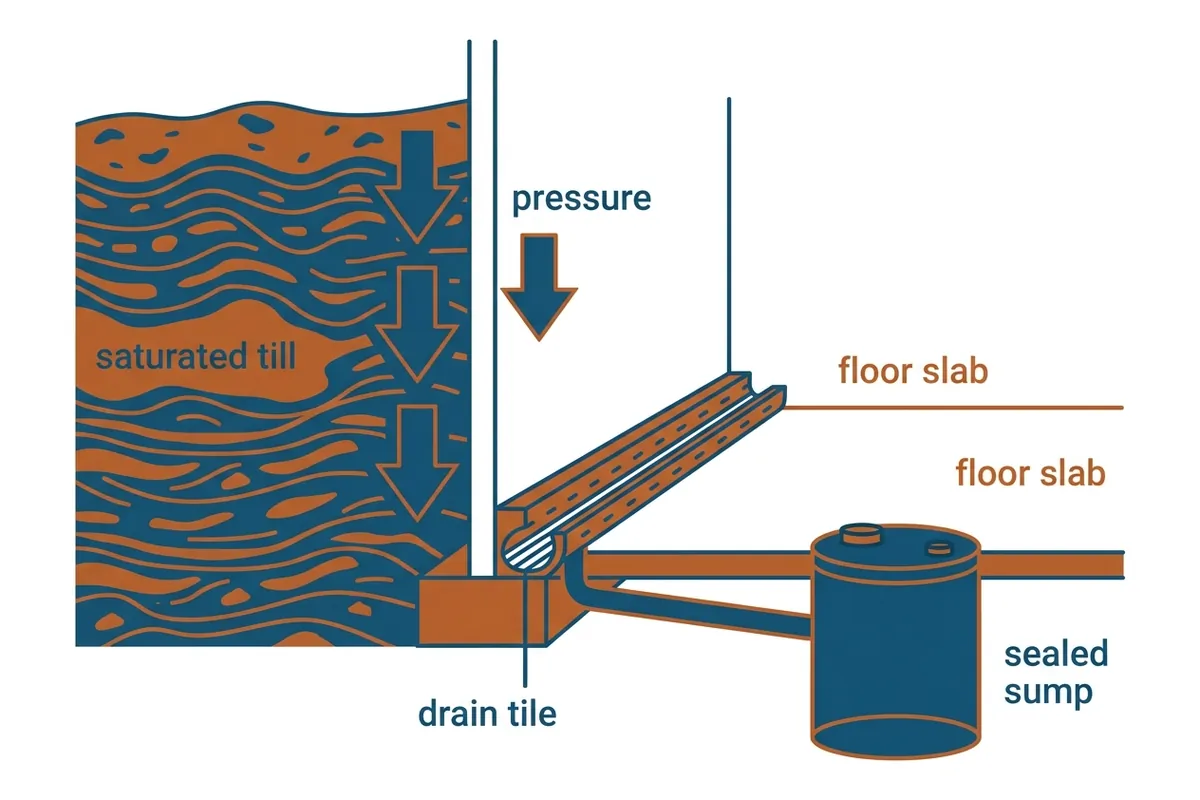
A basement wall is designed to resist soil pressure, and in most of the country that's a static number. Northeast Indiana adds two multipliers. First, the till behind your wall stays saturated through much of the year because it drains poorly — and saturated soil pushes considerably harder than dry soil, because you're supporting the water column too.
Second, winter. Frost drives deep into clay-rich soil here, and water expands roughly nine percent when it freezes. Backfill that's holding water becomes a hydraulic jack that loads the wall every hard freeze and unloads it every thaw, dozens of cycles a season. That cycling is why Fort Wayne walls bow rather than simply crack, and why the horizontal crack that shows up partway up a block wall — usually at the mortar joint where bending stress peaks — is this market's signature symptom.
Reading your own wall in five minutes
Hold a straightedge or drop a plumb line from the top of the wall to the floor and measure the largest gap. That number is your deflection, and it drives everything:
| Deflection | What it means | Typical repair | Range |
|---|---|---|---|
| Under 1 inch | Early, stable enough to plan around | Carbon fiber straps | $2,500–$5,000 |
| 1–2 inches | Established movement, load still active | Steel braces or wall anchors | $4,000–$8,000 |
| Over 2 inches, or shearing | Structural capacity compromised | Anchors with recovery, or rebuild | $8,000–$25,000+ |
Shearing — the wall sliding at the top where it meets the sill, or at the bottom where it meets the slab — changes the answer regardless of the deflection number. That one gets looked at soon.
The methods, and what each actually does
- Carbon fiber straps — bonded floor-to-sill on a prepared surface; resist further movement, add no thickness, and don't straighten anything
- Steel I-beam braces — anchored to the footing and floor joists; strong, and they occupy a few inches of floor space along the wall
- Wall anchors — plates set in the yard beyond the failure plane, tightened over months to recover deflection; need yard access
- Rebuild — the honest answer for sheared or deteriorated walls, and the one nobody wants to hear or quote
Water first, then steel
Every bowing wall scope we write in this market prices drainage alongside the restraint, and usually ahead of it. The reason is simple arithmetic: a strap resisting saturated, freezing backfill is fighting a load that interior drainage would have largely removed for a comparable price. Install restraint into an unmanaged water problem and you've bought strong steel and kept the mechanism. Manage the water and the same restraint holds with margin.
Where a bowing wall sits in the foundation repair sequence
Wall restraint is the third step in a Fort Wayne foundation repair, not the first. The order that holds on this ground runs: exterior water corrections (downspout extensions, restored grading — often a few hundred dollars), then interior drainage to relieve hydrostatic pressure, then the restraint itself, and cosmetic repair last once movement is provably finished.
Two exceptions move restraint to the front. Deflection past roughly two inches, and any shearing at the top or bottom of the wall, are structural situations that get addressed on their own timeline regardless of what the drainage plan looks like. Where a footing has also settled, the piering is sequenced with the wall work so nothing gets installed twice. Your written scope names the order and prices each line separately, so you can stage it if you want to.
Bowing wall questions, straight answers
How much bowing is too much?
Deflection under one inch is generally repairable with carbon fiber and is a repair to schedule rather than rush. Between one and two inches, braces or anchors are usually specified. Past two inches, or with shearing where the wall meets the sill or the floor, the wall may need rebuilding, and that determination belongs to a measured evaluation.
Does carbon fiber actually work?
For walls within its deflection range, yes — properly installed straps bonded to a prepared surface resist further inward movement and have no thickness to speak of, so the basement stays usable. What carbon fiber does not do is straighten a wall or remove the load causing the bow. Manage the water and the straps have an easy job.
Can a bowing wall be straightened?
Wall anchors and some brace systems can recover deflection gradually, tightened over months as exterior soil pressure is relieved. Anchors need yard space beyond the wall to set the plates, which rules them out on tight lots. Recovery is realistic on some walls and not others, and we say which before you buy anything.
Why does it look worse in late winter?
Because that's when the load peaks. Saturated backfill freezes, water expands about nine percent as it turns to ice, and the soil against your wall becomes a slow jack. Homeowners here commonly notice the crack widening or a new one appearing in February — the wall is reporting the season, not a sudden new problem.
Is my house in danger of collapse?
Almost never suddenly, and not without warning signs a measurement catches first. Basement walls fail progressively over years. The reason to act isn't imminent collapse — it's that repair cost climbs steeply with deflection: carbon fiber on a three-quarter-inch bow is a fraction of what rebuilding a sheared wall costs.
Get a free Fort Wayne foundation evaluation
Tell us what the basement is doing — water at the cove joint, a wall bowing inward, a horizontal crack in block, floors going out of level — and we’ll schedule an evaluation with photos, wall measurements, and floor elevations. We reply the same business day.